ENTERPRISE CASE STUDY · Infosys
Enterprise Data Archival System
Designed scalable solutions to archive and manage large enterprise datasets.
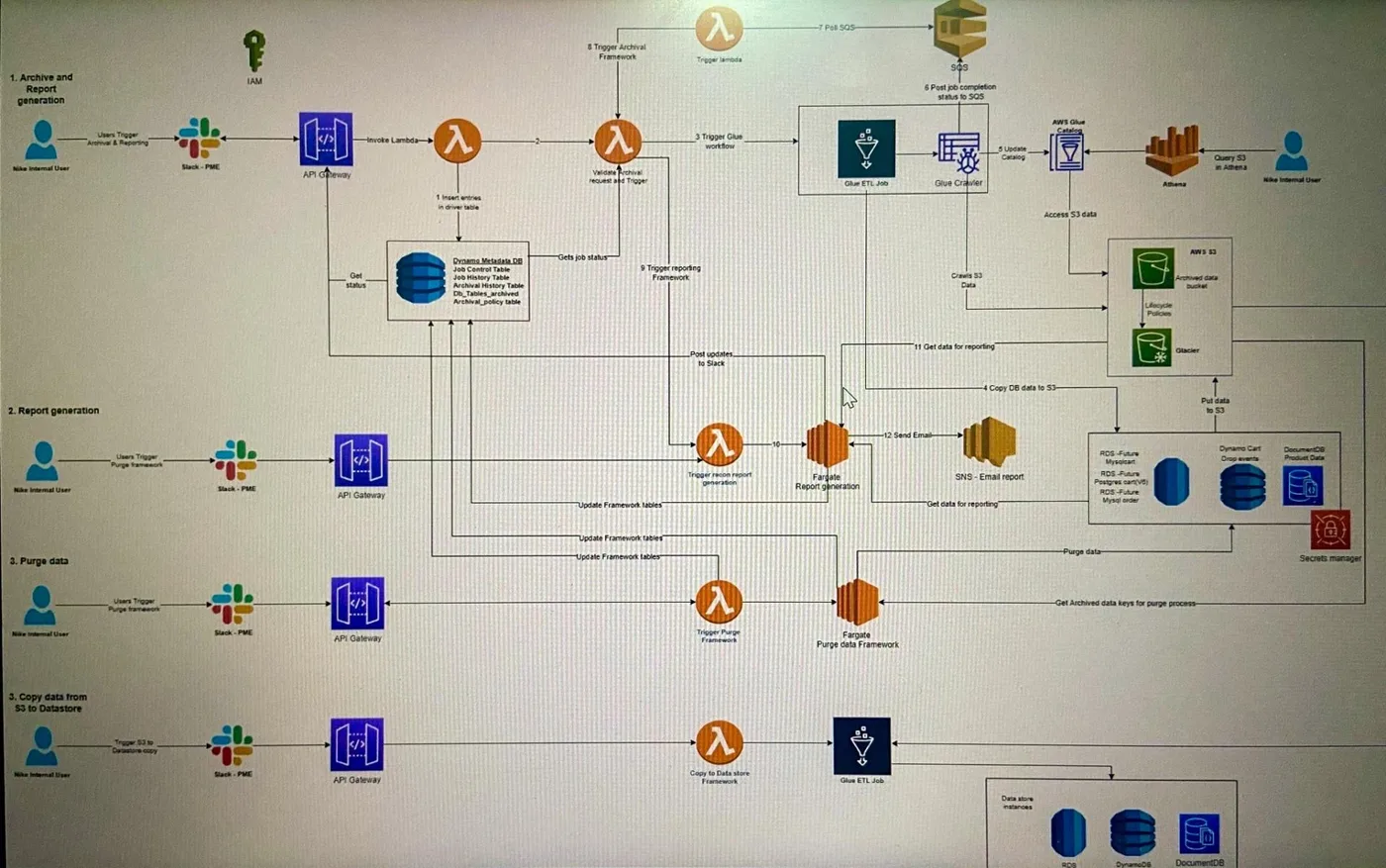
Project overview
This project focused on designing and implementing a robust database archival solution to move inactive data from production systems to AWS cloud storage.
The system ensures efficient archival, secure purging, and seamless restoration, integrated with a Slack-based interface for operational ease.
Project Description
The solution identifies legacy data no longer required for daily operations and migrates it into cost-effective AWS S3 storage. Post archival, data is purged from source systems while maintaining logs and reports for auditing.
The system also supports restoring archived data into new database instances and provides a user-friendly interface through Slack for triggering workflows and monitoring status.
Key Features
- Automated data archival from multiple databases to AWS S3
- Secure and scalable purge framework
- On-demand data restoration capability
- Slack-based user interface for triggering workflows
- Comprehensive logging and reporting system
- Event-driven architecture using AWS services
Technologies Used
Cloud: AWS (S3, Glue, Lambda, API Gateway, Fargate, DynamoDB) Processing: PySpark, Python Databases: RDS (MySQL, PostgreSQL), DynamoDB, DocumentDB DevOps: Terraform, Jenkins, GitHub
Architecture Highlights
- Data extracted from RDS, DynamoDB, and DocumentDB
- Processed using AWS Glue (PySpark jobs)
- Stored in Amazon S3 in optimized formats
- Glue workflows orchestrated ETL pipelines
- Lambda + API Gateway triggered workflows
- Fargate used for scalable purge execution
- DynamoDB used for logging and tracking operations
Roles & Responsibilities
- Gathered requirements and designed architecture for archival and purge systems
- Built POCs using AWS DMS, DataPipeline, and Glue
- Developed PySpark scripts for archival and restoration
- Created Glue workflows, triggers, and crawlers
- Developed Lambda functions integrated with API Gateway
- Engineered Python-based purge framework using AWS Fargate
- Implemented notification systems for job status
- Maintained logs and operational data in DynamoDB
- Generated reports for audit and tracking
- Collaborated with clients and teams through walkthrough sessions
Challenges & Solutions
- Challenge: Handling multiple database types Solution: Built unified PySpark-based ETL framework
- Challenge: Ensuring safe and reliable data purging Solution: Designed controlled purge workflows with logging
- Challenge: Orchestrating complex workflows Solution: Used Glue workflows with triggers and Lambda integration
Impact & Outcome
- Reduced database storage costs significantly
- Improved system performance by removing inactive data
- Enabled secure and traceable archival processes
- Provided seamless restoration for audit and compliance needs
- Delivered a scalable, reusable data lifecycle management solution
Future directions
Ideas identified for future development.
- AI-driven archival recommendations
- Integration with data cataloging tools
- Enhanced monitoring dashboards
- Policy-based automated archival scheduling
This case study summarizes professional work. Enterprise source code and internal data are not publicly available.