PERSONAL PROJECT · Personal Project
Engineering Knowledge Chatbot
AI chatbot that helps engineers find answers quickly.
Project overview
EngineerGPT is a knowledge copilot designed for engineering teams to interact with internal documentation through natural language queries.
It leverages Retrieval-Augmented Generation (RAG) to provide accurate, context-aware answers backed by source citations from real documents.
Project Description
EngineerGPT transforms static engineering documentation into an intelligent, searchable knowledge base by combining semantic search with AI-powered question answering.
The platform indexes documents using embeddings and enables users to retrieve precise answers along with source references, improving productivity and reducing time spent searching for information.
Key Features
- Document upload (PDF, Markdown, TXT)
- Automatic text chunking with context preservation
- Semantic embeddings using sentence-transformers
- Vector search powered by FAISS
- RAG-based question answering
- Source citations for every answer
- Confidence scoring for transparency
- Semantic search across all documents
- Chat-based conversational interface
- Knowledge dashboard for document tracking
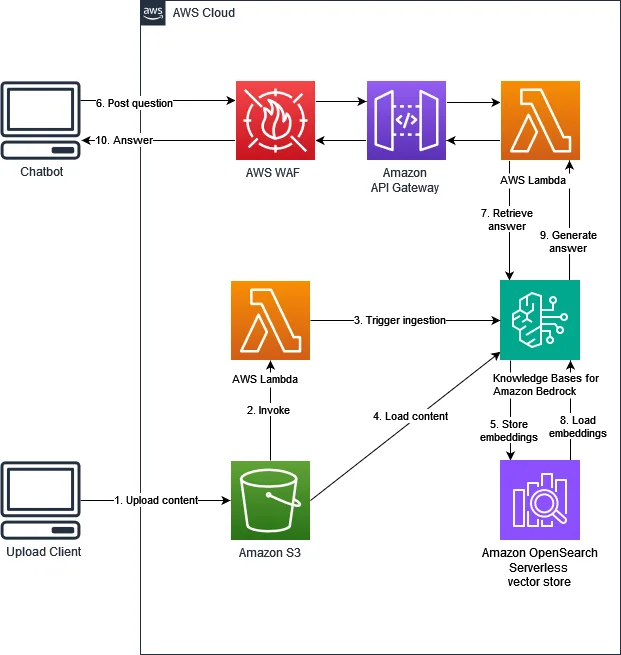
Architecture Components
- Frontend – React + Tailwind UI
- S3 – Document storage and frontend hosting
- API Gateway – Backend API layer
- Lambda – FastAPI backend execution
- Embedding Engine – Sentence-transformers (MiniLM)
- Vector Store – FAISS similarity search
- RAG Engine – Context-aware answer generation
Workflow Execution
- User uploads engineering documents
- Documents are parsed and chunked into smaller contexts
- Embeddings are generated and stored in vector index
- User asks a natural language question
- Relevant document chunks are retrieved using semantic search
- RAG engine generates answer with source citations
Key Advantages
- Transforms static docs into intelligent knowledge system
- Reduces time spent searching engineering documentation
- Provides explainable AI with source citations
- Scalable serverless architecture
- Improves team productivity and onboarding
Impact
- Enables faster knowledge discovery across teams
- Improves engineering efficiency and decision-making
- Reduces dependency on manual documentation search
- Provides centralized and intelligent documentation access